Brussels. You have kindly hosted me for over five years now.
Over time, I’ve gotten to know the multicultural areas of Anderlecht, the studentesque St Gillis, the upbeat Ixelles and the cosmopolitan Etterbeek – and above all the Eurocrat heaven of the European district.
Like many, I’ve complained about your many faults. Your built-in complexity that convinced some Belgium is a failed state, your ability in providing bad public service in either French or in bad Dutch, the poor infrastructure that makes me battle cars on my bike on a daily basis, the saddening climate where any day can be grey. Still, all this is wrapped in a layer of joie de vivre, exciting European multiculturalism and top class gastronomy (the best beers and fries of the world – and restaurants, too).
Despite her faults, Brussels is a place where I am happy. And even when you don’t love Brussels, you’ll love to hate it.
Bloody terrorists, do not touch Bruxelles ma belle. Do not take my happiness away.
A couple of years ago, I was involved in the communication around the TED talent search in Amsterdam. Part of TED’s search to have the best speakers, several candidates auditioned for a place at the stage of TED.
By far my favourite candidate was Max Zorn, a German-Dutch street artist. As an artist, he likes to be mysterious. He does few interviews. There are no pictures of him online. He typically wears sun glasses; during his talk he also wore a hat to be sure he remained incognito. Despite or maybe because of the mystery, he is one of my favourite artists – and the only one of which I personally own a work.
Max Zorn works with an uncommon material: brown packing tape.
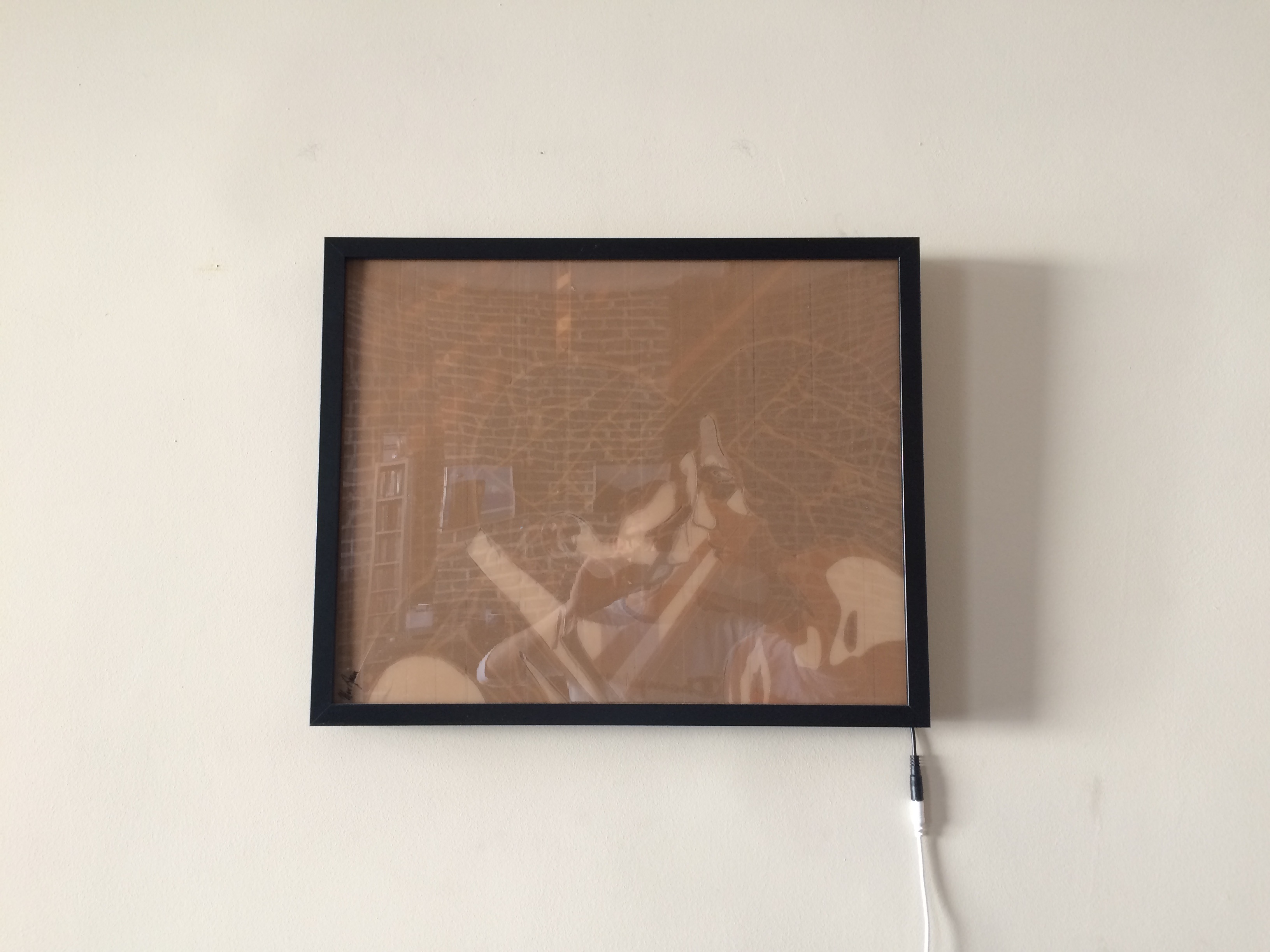
He puts layers and layers of tape on each other, and the image becomes visible through the contrast between the different number of layers and the light that passes through to them. Light has to behind for it to be effective – see here the painting that hangs proudly in my room.
This is the image by day, without light (and with a bit of a mirror effect of the glass…). Nothing too exciting, right?
But this is the image by night, with the light on:
In my interpretation, the couple exchanges a look that can mean many different things. Every time I see the picture, I see another element, and come up with another possible story about what it means. Most of the times, I see connection and intimacy. But from time to time, it can also mean love, or lust, or disappointment, or submission, or a battle for power…
And all these emotions are expressed just with three materials – brown packing time, glass, and light.
One final image, also taken from the retro style that is very much present in his work (for more, check his website and his shop)
For many ages to come the old Adam will be so strong in us that everybody will need to do some work if he is to be contented. We shall do more things for ourselves than is usual with the rich to-day, only too glad to have small duties and tasks and routines. But beyond this, we shall endeavour to spread the bread thin on the butter-to make what work there is still to be done to be as widely shared as possible. Three-hour shifts or a fifteen-hour week may put off the problem for a great while. For three hours a day is quite enough to satisfy the old Adam in most of us!
In his essay on “The Economic Possibilities of Our Grandchildren” from 1930, economist John Maynard Keynes famously predicted that in the future, people would only work fifteen hours a week. In hundred years, he wrote, the standard of life in progressive countries would be four to eight times higher than in 1930. In the extract above, he wrote that for ‘the old Adam’ in 1930, a fifteen-hour working week would be necessary to fairly divide the available work across the population.
With 14 years to go, there’s still a lot that needs to be changed!
Considering the gap between current working hours of 35 (officially in France), 40 hours for most and 50-60 or more for workaholics, maybe we should strive to reduce our working hours in smaller steps at first?
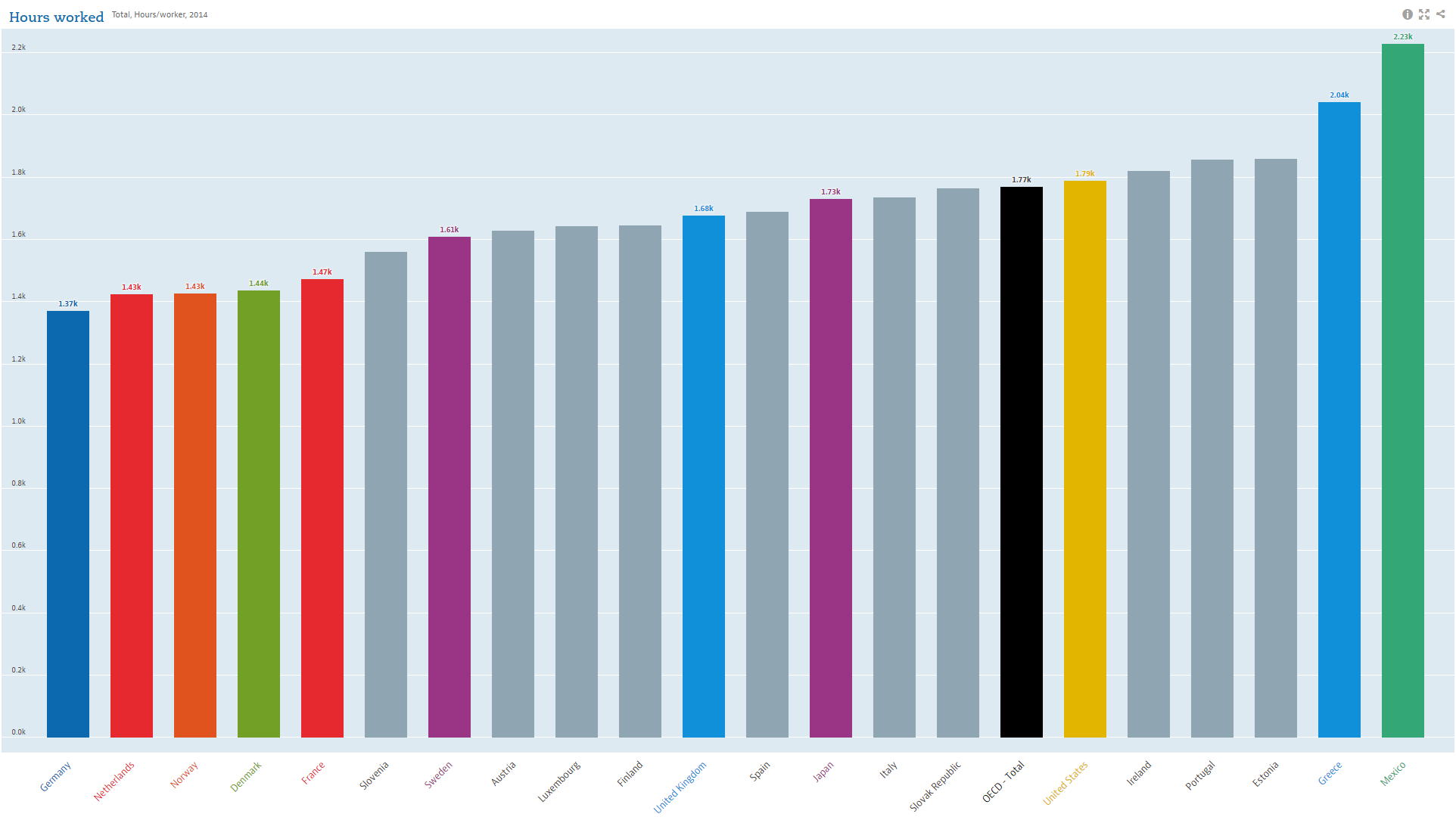
According to OECD data, the average working hours per year stands at 1770 hours per year across the OECD countries. These are not equally divided through the year (think of Easter, summer, and Christmas breaks): the weekly average is probably around 37 hours. These figures are actually worked hours, per worker, so including part-time workers and seasonal labour.
Against prejudices, the number of hours stands at 42 in Greece; in Germany and the Netherlands, the average is around 30. In the latter two, these figures are skewed by the high proportion of part-time workers, but also can be seen as a sign of high labour productivity! And surprisingly, it’s not Americans or Japanese that put in most hours. Instead, the workaholics of the OECD live in… Mexico. At 2238 hours per year and some 45 per year, the average person’s working week is some 50% longer than in Germany and the Netherlands.
Working hours in euro area and selected third countries (click to enlarge) Source: OECD
Step 1: down to 30 by 2020
What if we could achieve this level of 30 hours without these tricks? In their history, the Green and Socialist Parties in Sweden have aimed to reduce working hours to 30 per week. Scandinavian countries have a reputation for a healthy work-life balance and indeed are towards the left of the curve. Swedes work a bit more than the French with their 35-hour working week policy.
Last year, a retirement home in Gothenburg started to experiment with a 30-hour working week. Nurses tell researchers they feel they have more energy. The experiment is funded with a subsidy of around 500,000 euros to compensate for the higher number of staff needed to care for the residents.
But other examples cited in another article, such as creative and service industries, suggest that not so much more staff is needed. People still want to do a good job, and may achieve similar levels of productivity in six hours as in eight, says an app developer. With some testing and refinement, wouldn’t we able to get this rolled out by 2020?
Step 2: let’s get down to 21 by 2025
From the perspective of the new economics foundation, a think-tank on “economics as if people and the planet mattered”, getting down to 30 is good, but only halfway there. In a pamphlet and a TEDx talk, researcher Anna Coote argued for a 21-hour working week ambition (she herself, a recovering workaholic, is at 30 hours).
She argues that shorter working weeks would have a range of social and environmental advantages. For instance, it would distribute work more evenly across society, and hence reduce unemployment, and increase our ecological footprint. Now, we are getting close to Keynes’ expectations 85 years back. Doesn’t it sound utopian to work only four/five hours per day, four or five days per week? Or is it really feasible to do this within ten years, coinciding with decarbonisation of the economy and lower energy use to meet the targets of the COP21 climate change agreement?
Step 3: down to 15 by 2030 – or why not limit us to 4 hours?
But for the American dream, 21 hours is not good enough, and we might be able to do better than Keynes’ 15 hours. American dream salesman and self-help author Tim Ferriss wrote a well-known book entitled the ‘Four-Hour Working Week‘. In the book, he explains that for most entrepreneurs, a small amount of clients brings in most of the revenue. As such, by focusing on these, outsourcing all support functions, and living in low-cost countries, Ferriss claims it is possible to only work four hours a week. Whether you take this as a serious career option or too-good-to-be-true, it’s not a model that could apply to society as a whole.
If everybody were to work only four hours, our economic system would come to a stop. But Keynes 15 hours? If we really change our economy’s paradigm, maybe we can get it done by 2030…
When launching this blog, I called For A State of Happiness a blog without blah blah but with a mission. And to realise the mission – help our countries and societies to achieve a state of happiness – my words here online aren’t going to get me all the way. To be really effective I need to speak to people directly.
That’s why I am very happy to announce to of my speaking opportunities in the next weeks:
Pecha Kucha Brussels, Tuesday 26 January 20.00, Halles de Schaerbeek
Pecha Kucha is a Japanese presentation format. A presenter in this format will show 20 slides, for 20 seconds each. No loooooooong and boring speeches, but quick and dynamic presentations. After 6 minutes 40 seconds, time’s up and over to the next speaker.
I’ll be speaking on ‘Jasper, The Search for Happiness, & You’. I’ve identified four archetypes for happiness. Curious what Kim Kardashian, Nelson Mandela, Buddha, and a mountain climber can teach you about happiness? Come listen on Tuesday 26 January, in the Halles de Schaerbeek, Rue Royale St Marie 22.
Radio Alma, Monday 1 February 21.00-22.00, www.radioalma.eu (in Italian)
For the Italian speakers under my readers, tune in to Radio Alma on Monday 1 February from 21.00 to 22.00. Last year I spoke abut happiness, and now I’ll make a retrun visit speaking about my trip to Bhutan and what I learnt about happiness.
In 2015, the European migration crisis brought out the worst of many people. Hungary and several other countries on the Western Balkans route built fences. Population in destinations countries like Germany, Netherlands, Sweden and elsewhere protested out of anger and fear of asylum seekers, too often leading to violent confrontations. The Danish government undertook plans to seize asylum seeker’s personal goods. Sweden reduced mobility on the Oresund bridge, straining the connection between Copenhagen and Malmo and prompting Denmark to reintroduce border controls. The Schengen passport-free travel zone is under collapse. Populist parties reign in the polls in France, The Netherlands and elsewhere. The list goes on.
It is true that the large numbers of migrants put a strain on systems. It is impossible to orderly register and assist the amounts of people now. But it’s also useful to put the numbers in perspective: outgoing UN High Commissioner for Refugees Guterres pointed out that in absolute numbers, the 1 million people reaching Europe is high. But in relative numbers, compared to a population of over 500 million, the number is rather small, especially in comparison to the refugees received by Lebanon, Jordan and Turkey.
Ultimately, the refugees are not numbers, but people. A documentary shot on Lesbos by Dutch filmmakers Philip Brink and Marieke van der Velden shows this very clearly. In their documentary “The Island of All Together”, they pair refugees, most from Syria, with vacationers from the Netherlands, Germany and the UK. The people-to-people conversations between refugee and tourist show that ultimately, the human connection factor is stronger than prejudice and fear. A wonderful film showing the human face between the two sides of the crisis.
Happy start of 2016! I wish all my readers a year of achievement, inspiration and of course, happiness.
In early 2016, this blog will turn 2,5 years old. Since I entered the road to the discovery, I’ve now written just over one hundred post. I’m now in a much better position to answer the question what happiness is about. If I’d have to summarise what I learned in one phrase, it’d probably be the realisation how complex and simply happiness is at the same time.
Happiness is complex. It’s difficult to define and it’s difficult to pursue – the pursuit of happiness, this is even futile.
At the same time, happiness is very simple. We all know it when we are happy and are able to feel happiness. Intuitively, we very well understand that friends, family, and fun experiences are more likely to generate moments of happiness than material things or status.
And maybe we don’t need long lists of New Year Resolutions, but just some simple ideas to take steps towards (mine is to explore new recipes to cook!). Simplicity, humility and sometimes downright minimalism might be a worthwhile path to pursue.
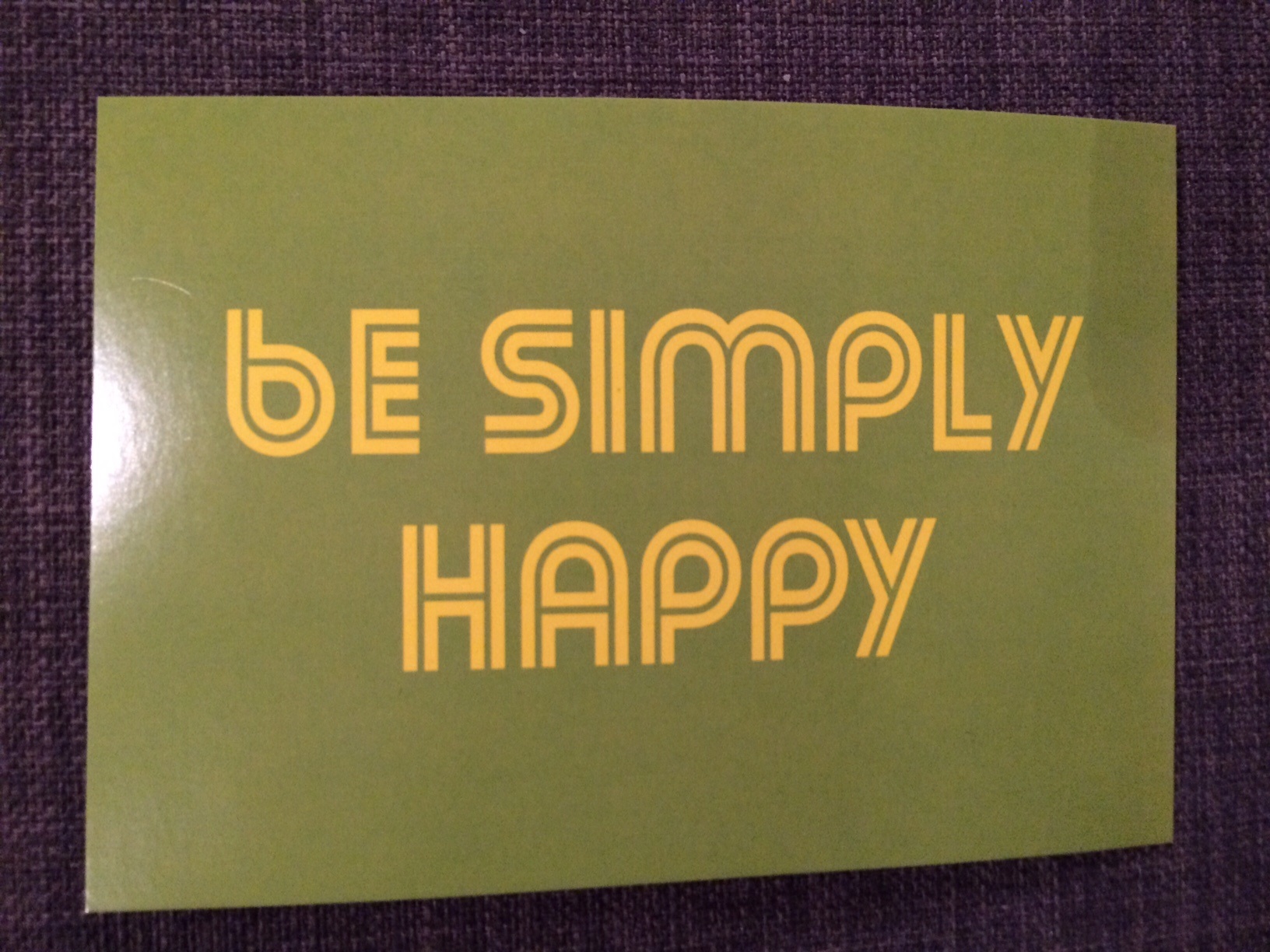
Or, as the card I picked up when 2016 was only a few hours old put it: Be simply happy.
In the beginning of this year, I formulated no less than ten New Year’s Resolutions. For me, the end of the year is the natural moment to look back and review what I experienced and achieved throughout the year.
This is how I did:
Live together with the girl I feel in love with last year
Yes! And it is a very special experience. Moving in together comes with some challenges. But these challenges are insignificant in comparison to the wonderful pleasure of being together every day.
Track and improve my sleep
Fairly well. Especially in the beginning of the year, I used sleep-tracking apps. They helped me somewhat improve my discipline in going to sleep and getting out to bed on time. But I haven’t systematically used them all year round. And my sleeping habits still can improve.
Expand my blog
Not bad. Especially after summer, I’ve opted for a somewhat slower frequency. I’ve taken the chance to take on some speaking occasions presenting my work in this field. But maybe most importantly, I’ve visited two ‘happy countries’ this year: Denmark and Bhutan.
Work on my health by running or by yoga
Could be better. I regularly do yoga, but not every week. And while I ran a personal best at the 5k (22 min 20 seconds!), I have only ran in training for that race, not all year round.
Celebrate my 30th birthday
Yes! And I celebrated it well, spending a weekend in the Belgian Ardennes with a group of friends.
Continue to do well at work
I think so. My role within our team has grown this year. And in the last week before the holidays, I won a new promotion (yeah!)
Travel to two new countries: Portugal and Bhutan (finally!)
Yes! I spent two weeks in both of them, discovering different towns and landscapes and learning a lot about their culture. And apart from these two, I also visited Denmark for the first time and made stopovers in Nepal and Qatar en route to Bhutan.
A little bit! A quick glance at my current happiness bookshelf suggests there aren’t too many additions: books on the November GNH conference in Bhutan and The Power of Negative Emotions being the exceptions. Still, (un)happiness was also a theme in other books that I read, such as Haruki Murakami’s title Norwegian Wood. And reading A History of the World in Twelve Maps also made me happy!
Become a better public speaker
Yes! Two and half years after joining, I finished Toastmasters International‘s Competent Communication programme. And I undertook some public speaking opportunities to talk about my discoveries on happiness.
Especially in the beginning of the year, I occasionally took a glance at the list to remind me what I wanted to achieve. But as the year progress, I took more and more distance. And now, I don’t even understand why I needed ten goals.
Goals are helpful to meet objectives and develop yourself. But if there is one goal I have for 2016, it is to have less goals…
What is Gross National Happiness (GNH) actually good for? And how do policymakers in Bhutan really use their unique development tool?
In previous posts, I’ve dived into the methodology of GNH and crunched some of numbers behind the 43,4% of happy Bhutanese. GNH was once developed to provide an alternative to the logic of mere economic development. Obviously, in the end GNH is as good or as bad as it will be used. As an observer, it seems that Bhutan stands close to GNH, for instance in environmental policy and community life.
But to really know how it works, I asked Kent Schroeder at Humber College, Canada to help me find out if GNH leads to different government decisions. He should know: he did his PhD on the implementation of GNH in Bhutan, and interviewed around 150 policymakers on all levels.
Who’s doing GNH?
Schroeder told me that several Bhutanese institutions are working on GNH: the GNH Commission, the think tank Centre for Bhutan Studies (CBS), and the government.
The GNH Commission is a powerful body that is consulted by the government on the GNH effects of new policy initiatives. It’s reviewing new public policy initiatives before adoption. And the GNH Commission even publishes draft policies online, allowing the public to comment.
In addition, there is a policy screening tool, through which the Commission reviews the impact of a prospective policy on the nine domains of GNH. The tool scores all elements of the policy on a scale from 1 to 4: 1 means a negative impact, while 4 means a positive impact. In the EU bubble, we would call this a happiness impact assessment!
The most prominent example of the use of the policy screening tool leading to different results was the question on whether Bhutan should join the World Trade Organisation (WTO). After reviewing the consequences on GNH, the GNH Commission advise against becoming party to global free trade rules.
The CBS is also a highly recognised think tank, and is the driving forced behind the GNH index I’ve written so much about.
And then of course there are all policymakers at national, district and local level who formally all are required to follow the concept of GNH in their policies. Schroeder tells me that the GNH principle is taken into account for Bhutan’s five-year plans. In the next cycle, GNH will be devoluted, meaning that local administrations should take more responsibility. Officials can use local checklists similar to the national screening.
Does it work?
So, the means are there to effectively integrate GNH in public policy. But does it work in practice? To answer that question, Schroeder in his PhD thesis research reviewed four policy areas, namely media, tourism, farm roads, and human-wildlife conflict.
His conclusions about the effectiveness of GNH policies are as follows:
The influence of GNH on policy actions is unpredictable. Policies are shaped in a complex policy process, and the level of influence of different actors across policy areas and districts. As such, the impact of GNH policy tools on policy processes is limited.
Bhutanese citizens, and even policy makers, often do not understand what GNH really means. There is no common concept and these different interpretations also affect the policy process. Simply put, GNH is often not understood!
As a result, the outcome varies per policy area. Media and tourism policies largely reflect the aims of GNH. For farm roads, on the short term policy conforms with the GNH concept, but on the long term, Schroeder doubts its effect on sustainability. Finally, for the policies on the interaction on human and wildlife – a real issue in Bhutan where farmers often have to stay awake in the night to chase animals from their farmland – the result is mixed. This is also a consequence of the ambiguity of GNH.
Common values ensure GNH
Reading this, one would doubt the relevance of GNH as a concept. But there is no reason to be so dire. Even though the process is not as structured as the concept would suggest, the underlying values used by policy makers in determining their course of action typically conform with the values of GNH. As such, policy outcomes often reflect what GNH would imply – even if they’re not recognised as being connected with GNH!
Last month, I had the opportunity to discuss this question with a group of smart and inspiring members of the Young Professionals in Foreign Policy. I gave them a workshop about happiness at work.
It’s a pity I had to focus on my own parts in leading the workshop so much that I didn’t make detailed notes about their questions and comments. They made me realise how many people are struggling to determine what a good workplace is for them – and if they aren’t better off elsewhere. But I also found out that virtually everybody is able to point at something they love about their work.
I remember the inspiring answers I got when asking what made my guests happy at their work place. Answers included:
Working together with great colleagues and friends (by far the most common answer!)
Having a purpose or meaning
Doing something in a field I am passionate about
Developing and using skills that I want to work on
Are you interested to invite me for a speech or workshop on happiness at work or another topic related to happiness? Just get in touch at jasper [at] forastateofhappiness.com.
According to the 2015 Gross National Happiness (GNH) survey, 43,4% of the Bhutanese are considered happy.
This figure is the outcome of the survey by the Centre for Bhutan Studies and GNH research for 2015. During the survey, researchers interviewed 7.153 respondents, asking them 148 questions each to distill their GNH. The number came about via a complex methodology, which is about a lot more than just asking people about their life satisfaction.
How are people happy?
8.4% of Bhutanese are ‘deeply happy’ (or scoring over 77% of the weighted indicators), against 8.3% in the 2010 survey.
35.0% are ‘extensively happy’ (score of 66-76%), going up from 32.6% in 2010
47.9% are ‘narrowly happy’ (score of 50-65%). In 2010, this group of narrowly happy people was larger, at 48.7%
Only 8.8% are considered ‘unhappy’ (below 50%) in 2015, while in 2010, 10.4% were unhappy.
This shows a small increase of GNH between 2010-2015. But as Bhutanese Prime Minister Tshering Tobgay said when presenting the results during the GNH conference, we cannot really interpret what this increase means:
“Is this [increase in GNH] fast or slow? We don’t know.”
Some of the other outcomes:
Urban up, rural more slowly
People are happier in urban areas and the improvement is stronger in urban areas than in rural areas (the survey is designed to be representative for both the urban and rural area in every of Bhutan’s 20 districts).
This is quite remarkable given the quick modernisation and urbanisation. As CBS researcher Thsoki Zangmo told me, Bhutanese living in cities score better on living standard and education, but worse on community and cultural indicators. This might suggest that the departure of people to the city affects community life in rural place of origin more than in the city, the destination.
But these findings are provisional – the CBS will publish more detailed analysis next year. And, Tshoki says, we need more data points to really understand these factors. Therefore, the survey will be repeated every three of four years.
More happiness for everybody
Roughly, improvements seem to be equalising: improvements are stronger under disadvantaged groups (women, elders, uneducated, and farmers). However, the survey design is not representative so these findings are indicative
Smaller downs, bigger ups
Confusingly, no less than 14 individual domains and indicators show decreases. However, these are more than offset by (larger) increases in 11 indicators. Roughly, ‘harder’ domain as living standards and health improve, while ‘softer’ ones like community vitality and psychological well-being decrease.
Dreaded government offers good services
A final remarkable finding is that the young Bhutanese democracy – established 2008 – quickly has created a complex relation with politics. As Prime Minister Tobgay didn’t shy away from mentioning, the perception of government is down by 48 percentage points. Both Tobgay and the researchers contributed that to the euphoria about the new democracy resulting in a high score in 2010, whilst electoral bickering in 2013 may have reduced the number in the 2015 survey.
At the same time, however, the satisfaction with government services has increased by 20 percentage points. In short, Bhutanese are very satisfied with public services delivered by a dreaded government!